Iron Oxide Silica Fe3O4@SiO2 Nanoparticles
Available Pack Size:10gms, 25gms, 50gms, 100gms, 250gms, 500gms, 1Kg & Bulk Orders, High Purity
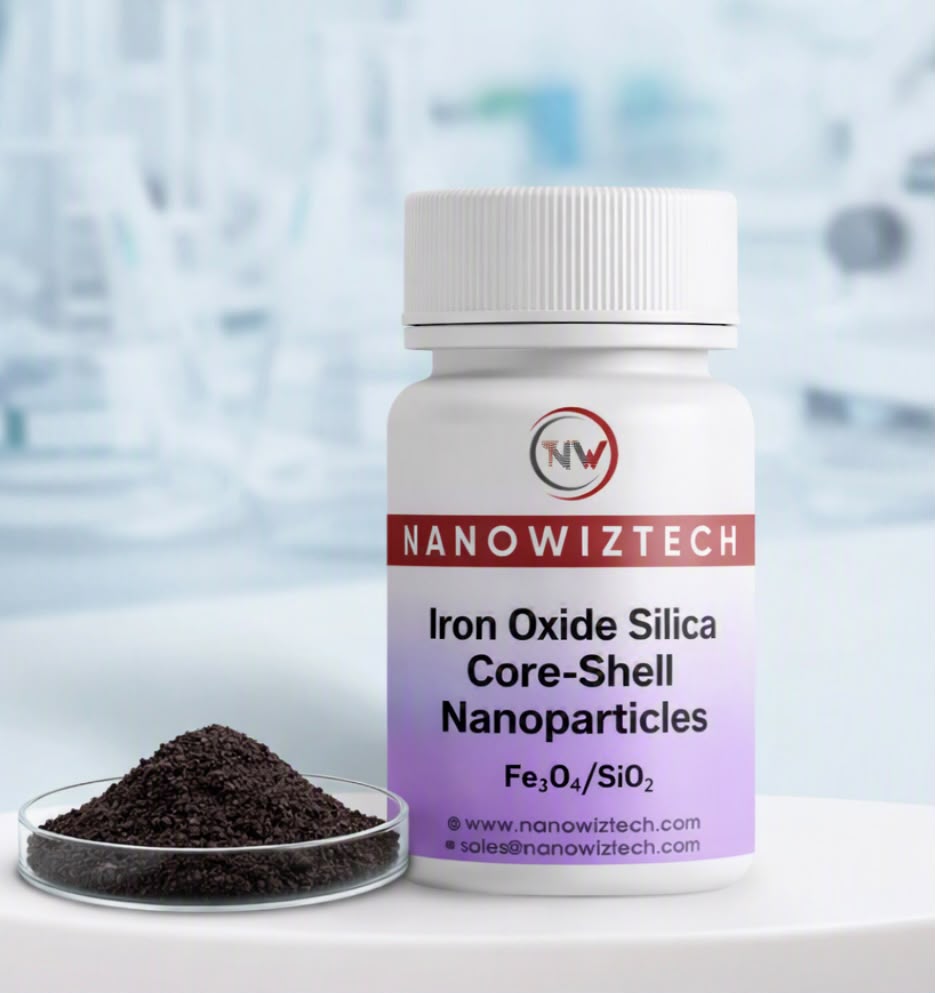
NanowizTech Iron Oxide Silica Core-Shell Nanoparticles, Fe₃O₄@SiO₂, designed for research and advanced nanotechnology applications. NanowizTech is a manufacturer and supplier of iron oxide silica core-shell nanoparticles with controlled core-shell structures and customizable specifications.
NanowizTech Iron Oxide Silica Core-Shell Nanoparticles, represented by the formula Fe₃O₄@SiO₂, are advanced hybrid nanomaterials that combine the magnetic characteristics of an iron oxide core with the chemical and surface-related advantages of a silica shell. This core-shell architecture makes Fe₃O₄@SiO₂ nanoparticles attractive for research and development in nanotechnology, magnetic materials, catalysis, separation science, sensing, biotechnology, environmental technologies, and other advanced material applications. The company states that it provides high-quality nanomaterials, characterization services, application-development support, and customized synthesis for research and industrial requirements.
Product | Iron Oxide Silica Core-shell Nanoparticles | |
|---|---|---|
Stock No. | NW-3205-08-125 | |
CAS | NA | Confirm |
Purity | 99.99% | Confirm |
Molecular Formula | Fe3O4@SiO2 | Confirm |
Core | Iron Oxide (Fe3O4) | Confirm |
Shell | Silica(SiO2) | Confirm |
Form | Powder | Confirm |
Color | Dark Gary to Brown | Confirm |
Solubility | Organic, Customized | Confirm |
APS | 20nm-90nm | Confirm |
Shell Thickness | Customized | Confirm |
Storage Condition | Room Temperature | Confirm |
Application | Bioimaging and Biomedicine | Confirm |
Main Inspect Verifier | QC In charge | Confirm |
Note: Product Specification are subject to amendment and may change over time.
NanowizTech Iron Oxide Silica Core-Shell Nanoparticles (Fe₃O₄@SiO₂): High-Purity Nanomaterials for Advanced Applications:
Fe₃O₄@SiO₂ nanoparticles are particularly interesting because their two-component structure allows researchers to take advantage of the magnetic response of magnetite while using the silica layer as a chemically versatile outer surface. In practical applications, the silica shell can help provide a functional surface for further modification while maintaining the useful properties of the iron oxide core.
For customers searching for high-purity Fe₃O₄@SiO₂ nanoparticles, iron oxide silica core-shell nanoparticles, magnetite silica nanoparticles, magnetic silica nanoparticles, or Fe₃O₄@SiO₂ nanomaterials, NanowizTech provides a nanomaterial-focused sourcing option with customized material capabilities.
What Are Fe₃O₄@SiO₂ Core-Shell Nanoparticles?
Fe₃O₄@SiO₂ nanoparticles consist of two primary components:
- Core: Magnetite, Fe₃O₄
- Shell: Silicon dioxide, SiO₂
- Structure: Core-shell nanoparticle
- Formula: Fe₃O₄@SiO₂
- Material category: Magnetic silica-coated iron oxide nanomaterial
The “@” symbol in Fe₃O₄@SiO₂ indicates a core-shell arrangement, meaning Fe₃O₄ forms the inner core and SiO₂ forms the surrounding shell.
Magnetite is an iron oxide with well-known magnetic behavior. At nanoscale dimensions, magnetite particles can exhibit particularly useful magnetic characteristics, including superparamagnetic behavior under suitable particle-size and structural conditions. Published research on Fe₃O₄@SiO₂ has demonstrated crystalline magnetite cores surrounded by amorphous silica shells and reported room-temperature superparamagnetic behavior in appropriately prepared particles.
Key Properties of Fe₃O₄@SiO₂ Nanoparticles:
1. Magnetic Fe₃O₄ Core
The Fe₃O₄ core provides the principal magnetic functionality of the material. Magnetite nanoparticles are widely studied for magnetic separation, magnetic manipulation, sensors, catalysis, and other technologies.
When the particle dimensions and synthesis conditions are appropriately controlled, Fe₃O₄ nanoparticles can exhibit superparamagnetic behavior. Research on Fe₃O₄@SiO₂ specifically has reported superparamagnetic properties at room temperature for suitable core-shell particles.
2. Silica Surface
The SiO₂ shell creates an outer surface that is chemically different from bare Fe₃O₄. Silica is widely used as a coating material because it provides a stable inorganic interface and can support further surface modification.
The shell thickness can be engineered during synthesis. Scientific research has shown that Fe₃O₄@SiO₂ particles can be produced with controlled silica-shell thickness, demonstrating the importance of synthesis parameters in determining final nanoparticle structure.
3. Core-Shell Architecture
The core-shell configuration allows researchers to combine different functionalities in a single nanoscale structure.
The Fe₃O₄ core contributes magnetic properties, while the SiO₂ shell provides a functionalizable surface and modifies interactions between the magnetic core and the surrounding environment.
This architecture can therefore be useful when a researcher wants magnetic functionality without exposing the bare magnetic nanoparticle surface directly to the application environment.
4. Tunable Surface Chemistry
Silica surfaces can be chemically modified using suitable functional groups and coupling strategies. This makes Fe₃O₄@SiO₂ a useful platform for developing application-specific nanomaterials.
Depending on the intended application, researchers may investigate functionalization involving amine, carboxyl, thiol, polymeric, or other surface chemistries.
5. Dispersibility
The silica shell can influence nanoparticle dispersion and surface interactions. Proper dispersion is particularly important in applications involving liquids, coatings, polymers, composites, catalysis, and biological research.
The actual dispersion behavior depends on particle size, shell thickness, surface treatment, solvent, ionic strength, pH, concentration, and other formulation parameters.
6. High Surface-to-Volume Ratio
Like other nanoparticles, Fe₃O₄@SiO₂ materials have a high surface-area-to-volume ratio compared with conventional bulk materials. This makes the outer silica interface especially relevant in applications where surface interactions are important.
7. Customizable Structure
Core diameter, shell thickness, surface functionality, particle-size distribution, and dispersion medium can potentially be tailored for different research objectives.
NanowizTech states that it offers custom synthesis based on customer requirements, which can be useful for specialized nanotechnology projects.
Chemical Formula
The commonly used structural formula for these nanoparticles is:
Fe₃O₄@SiO₂
Here:
- Fe₃O₄ = magnetite iron oxide core
- SiO₂ = silicon dioxide or silica shell
- @ = core-shell architecture
It is important to distinguish Fe₃O₄@SiO₂ from a simple physical mixture of Fe₃O₄ and SiO₂ powders. A core-shell nanoparticle has a defined architecture in which silica is formed around or deposited onto the iron oxide core.
Applications of Fe₃O₄@SiO₂ Nanoparticles
The combination of magnetic behavior and a silica surface makes Fe₃O₄@SiO₂ relevant to a wide range of research fields.
Magnetic Separation
One of the most important potential applications is magnetic separation.
Because the Fe₃O₄ core responds to magnetic fields, functionalized Fe₃O₄@SiO₂ nanoparticles can be investigated for separating target molecules, particles, catalysts, contaminants, or biological materials from liquid systems.
A researcher can potentially attach a selective surface chemistry to the silica shell while using an external magnetic field to facilitate particle recovery.
Catalysis
Fe₃O₄@SiO₂ nanoparticles can serve as supports or platforms for catalytic research.
The magnetic core may facilitate recovery of the nanomaterial from reaction mixtures, while the silica surface can provide a platform for immobilizing catalytic species.
This combination is attractive for research into reusable heterogeneous catalysts and magnetic catalyst supports.
Environmental Research
Magnetic nanoparticles are frequently investigated for environmental remediation and contaminant removal.
A functionalized Fe₃O₄@SiO₂ material may be designed to interact with specific contaminants and subsequently separated from water or another medium through magnetic manipulation.
Potential research areas include adsorption, pollutant capture, water treatment, and recovery of engineered adsorbents.
Chemical Sensors
The surface of silica-coated magnetic nanoparticles can be functionalized with recognition molecules or chemical groups.
This makes Fe₃O₄@SiO₂ a potential platform for developing nanoscale sensors and detection systems.
Researchers can combine the magnetic properties of Fe₃O₄ with the surface chemistry of SiO₂ to create multifunctional sensing materials.
Bioscience and Biomedical Research
Fe₃O₄@SiO₂ nanoparticles have been studied in biomedical research because their magnetic cores and modifiable silica surfaces can provide multiple functions within a nanoscale system.
Published research has investigated Fe₃O₄@SiO₂-related structures for biomedical applications and reported approaches for controlling silica-shell thickness and magnetic performance.
However, research-grade Fe₃O₄@SiO₂ nanoparticles should not automatically be assumed to be approved for clinical, diagnostic, therapeutic, pharmaceutical, food, or human-use applications. Any such application requires appropriate regulatory, toxicological, biocompatibility, sterility, and formulation evaluation.
Drug-Delivery Research
Functionalized magnetic silica nanoparticles are also investigated as experimental platforms for controlled delivery and targeted research systems.
The silica shell can provide a surface for functionalization, while the magnetic core can provide magnetic responsiveness.
Why Choose Core-Shell Fe₃O₄@SiO₂
Bare Fe₃O₄ nanoparticles are useful magnetic materials, but their surface characteristics may not be ideal for every application.
Adding a silica shell can provide several advantages:
Surface functionalization: The silica interface can be modified for application-specific chemistry.
Improved interface control: The shell creates a defined interface between the magnetic core and surrounding environment.
Magnetic functionality: The Fe₃O₄ core remains the source of magnetic response.
Versatility: The same basic Fe₃O₄ core can potentially be adapted for different applications through changes in shell properties and surface functionalization.
Research flexibility: Core-shell nanoparticles can be incorporated into experimental platforms involving separation, catalysis, sensing, composites, and nanobiotechnology.
Why NanowizTech?
NanowizTech’s stated expertise covers nanomaterial manufacturing, nanoscience, customized nanomaterials, characterization, and application-development support. Its portfolio spans multiple nanoparticle categories, including iron oxide, silica, carbon materials, metal nanoparticles, dispersions, core-shell structures, and other advanced materials.
Customers can consider NanowizTech when they need:
- High-quality nanomaterials
- High-purity nanoparticle options
- Core-shell nanomaterials
- Customized particle specifications
- Research-grade materials
- Technical support
- Characterization services
- Bulk or project-based sourcing
- International supply options
The company also lists iron oxide and silica products separately in its nanopowder portfolio, including magnetite Fe₃O₄ and silica SiO₂ materials, demonstrating experience with both components used in Fe₃O₄@SiO₂ systems.
Frequently Asked Questions
What is the formula of iron oxide silica core-shell nanoparticles?
The commonly used structural formula is Fe₃O₄@SiO₂, representing a magnetite Fe₃O₄ core surrounded by a silica SiO₂ shell.
What does Fe₃O₄@SiO₂ mean?
The notation means that Fe₃O₄ forms the nanoparticle core and SiO₂ forms the outer shell. The “@” symbol is commonly used to describe core-shell architecture.
Are Fe₃O₄@SiO₂ nanoparticles magnetic?
The Fe₃O₄ core provides magnetic behavior. Depending on particle size and synthesis conditions, Fe₃O₄@SiO₂ nanoparticles can exhibit superparamagnetic characteristics. Research has reported room-temperature superparamagnetic behavior in appropriately prepared Fe₃O₄@SiO₂ nanoparticles.
What is the purpose of the silica shell?
The silica shell provides an outer inorganic interface that can alter surface properties and offer opportunities for further functionalization. It can also help separate the magnetic core from the surrounding environment.
What are Fe₃O₄@SiO₂ nanoparticles used for?
Potential research applications include magnetic separation, catalysis, sensing, environmental technologies, nanocomposites, surface functionalization, and biomedical or biotechnology research.
Can the silica shell thickness be customized?
Core-shell synthesis can allow control over silica-shell thickness, and published research has demonstrated controlled shell thickness in Fe₃O₄@SiO₂ systems. NanowizTech also states that it offers custom synthesis according to customer requirements.
Are these nanoparticles available in high purity?
NanowizTech’s product portfolio includes high-purity Fe₃O₄ and SiO₂ nanomaterials, including products with stated 99.9% purity. Exact purity for a particular Fe₃O₄@SiO₂ core-shell product should be confirmed from the current product specification and certificate of analysis.
Does NanowizTech provide customized nanomaterials?
Yes. NanowizTech states that it provides custom synthesis according to customer requirements and offers a range of nanomaterial forms and specialized products.
Can customers request bulk quantities?
Quantity, packaging, production scale, and availability should be confirmed directly with NanowizTech because requirements can differ by specification and project.
Does NanowizTech offer international shipping?
NanowizTech nanomaterial supplier serving scientific and industrial users. Customers should confirm current international shipping availability, documentation, destination restrictions, and delivery terms for their specific order.
Order High-Purity Fe₃O₄@SiO₂ Nanoparticles from NanowizTech
For laboratories, universities, R&D organizations, manufacturers, and technology companies looking for iron oxide silica core-shell nanoparticles, Fe₃O₄@SiO₂ offers a powerful combination of magnetic functionality and silica-based surface chemistry.
NanowizTech provides a broad nanomaterial portfolio and supports customized nanomaterial development. Its existing product range includes magnetite Fe₃O₄, silica SiO₂, oxide nanoparticles, dispersions, and core-shell materials.