Aluminium Oxide Nanoparticles Dispersion -High Purity
High purtiy 99.9%, Global Shipping, CAS No 7440-50-8, Water based-Colloidal Dispersion (Customized)
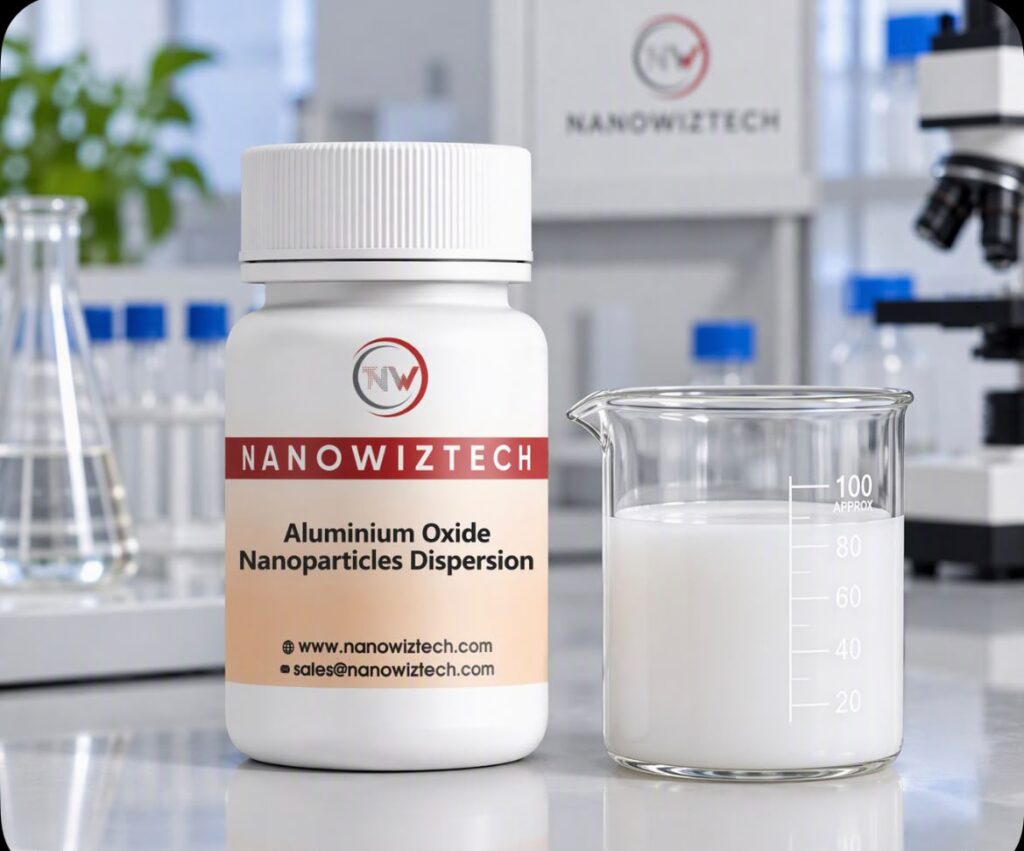
NanowizTech presents Aluminium Oxide Nanoparticles Dispersion (Al₂O₃), a nanomaterial product intended for relevant research and industrial applications. Identified by CAS No. 1344-28-1, this product can be evaluated according to its dispersion characteristics, particle specifications, and intended application requirements.
Product | Aluminium Oxide Nanoparticles Dispersion | |
|---|---|---|
Stock No. | NW3205-08-132 | |
CAS | 1344-28-1 | Confirm |
Purity | 99.9% | Confirm |
Formula | Al2O3 | Confirm |
Concentration | 1000ppm, 20wt%, 40wt%(customized) | Confirm |
APS | 20-30nm | Confirm |
Color | White-Off White | Confirm |
Density | ~ 1.2/cm3 | Confirm |
pH | 7 | Confirm |
Solvent | Water(ddH20), (as per requirement) | Confirm |
Main Inspect Verifier | QC In charge | Confirm |
Note: Product Specification are subject to amendment and may change over time.
Aluminium Oxide Nanoparticles Dispersion (Al₂O₃) – High Purity Manufacturer and Global Supplier | NanowizTech
NanowizTech presents Aluminium Oxide Nanoparticles Dispersion (Al₂O₃), an advanced nanomaterial designed for applications that require the characteristic properties of aluminium oxide in a suitable dispersion format. Aluminium oxide, also known as alumina, is an important inorganic material valued for its hardness, thermal stability, chemical resistance, electrical insulating characteristics, and versatility in advanced material development.
With increasing demand for high-performance materials across research laboratories, manufacturing industries, electronics, coatings, ceramics, and surface engineering, aluminium oxide nanoparticles have become an important area of nanotechnology development. Their nanoscale dimensions can provide a high surface-area-to-volume ratio, making them useful in applications where particle size, surface interactions, dispersion quality, and material performance are important.
What Is Aluminium Oxide Nanoparticles Dispersion?
Aluminium oxide nanoparticles are extremely small particles of aluminium oxide engineered for applications that benefit from nanoscale material characteristics. Aluminium oxide is a ceramic oxide composed of aluminium and oxygen. It is widely used in industrial materials because of its mechanical strength, thermal resistance, chemical stability, and insulating properties.
An aluminium oxide nanoparticle dispersion consists of alumina particles distributed throughout a liquid carrier medium. Depending on the formulation, the liquid may be selected to suit a particular processing method, coating system, laboratory procedure, or industrial application. The dispersion format can simplify the incorporation of nanoparticles into suitable formulations compared with handling dry nanopowders, although actual performance depends on the dispersion composition and processing conditions.
Particle size distribution, solids concentration, surface chemistry, carrier liquid, stabilisation method, and storage conditions can all influence dispersion behaviour. These parameters should be considered when selecting an aluminium oxide dispersion for a specific purpose.
Key Properties of Aluminium Oxide Nanoparticles Dispersion:
- High Hardness and Wear Resistance
- Thermal Stability
- Chemical Resistance
- Electrical Insulation
Why Choose High-Purity Aluminium Oxide Nanoparticles Dispersion?
Selecting the right aluminium oxide dispersion requires attention to chemical identity, formulation quality, technical support, supply consistency, and cost.
NanowizTech provides a point of contact for customers seeking information about Aluminium Oxide Nanoparticles Dispersion (Al₂O₃) for research and industrial evaluation.
Application-Oriented Product Selection
Different applications require different particle sizes, concentrations, surface properties, and carrier liquids. Buyers should select a grade based on their processing method and performance targets rather than assuming that a single formulation suits every application.
Documented Quality Requirements
For quality-sensitive applications, request the relevant certificate of analysis, technical data sheet, safety data sheet, and available batch information. These documents help buyers assess product identity, purity, concentration, handling requirements, and suitability.
Flexible Purchasing Enquiries
Customers can discuss required quantities, packaging, technical specifications, and delivery expectations before purchasing. Availability of particular grades and pack sizes should be confirmed with the supplier.
Cost-Conscious Procurement
Competitive material sourcing can help businesses manage research budgets and manufacturing costs. The most appropriate comparison considers the price per unit of active aluminium oxide, concentration, purity, quality documentation, packaging, freight, and applicable import charges.
International Supply Enquiries
For customers outside the domestic market, shipping arrangements can be discussed according to destination, order size, packaging requirements, product classification, and applicable transport regulations.
Aluminium Oxide Nanoparticles Dispersion at Competitive Prices
Price is an important consideration when sourcing high-purity nanomaterials for laboratories, industrial production, and research projects. The total cost of aluminium oxide nanoparticle dispersion may vary according to purity, particle size, concentration, dispersion medium, surface treatment, packaging, order quantity, and testing requirements.
Comparing products solely by price per bottle or kilogram may not provide a complete picture. For liquid dispersions, customers should consider the concentration of aluminium oxide and calculate the cost relative to the actual amount of active material supplied.
How to Select the Right Aluminium Oxide Nanoparticle Dispersion?
The correct dispersion depends on the intended use and the processing conditions. Before requesting a quotation, consider the following technical parameters.
Particle size: Identify the required average particle size and particle size distribution. Confirm the measurement method and whether the reported value refers to primary particles or dispersed particles.
Purity: Determine the minimum purity and allowable impurity levels for the intended application. Request supporting documentation where required.
Concentration: Check the solids content or aluminium oxide concentration to ensure that the formulation provides the required quantity of active material.
Dispersion medium: Confirm whether the carrier is water, an organic solvent, or another liquid. Compatibility with the target process is essential.
Dispersion stability: Consider sedimentation, aggregation, storage duration, and any recommended mixing or redispersion procedures.
Surface treatment: Establish whether the particles are untreated or modified and whether additives are present.
Application compatibility: Evaluate whether the formulation is suitable for your coating, polymer, ceramic, or research process.
Packaging and storage: Confirm container material, storage temperature, shelf life, and handling instructions using the supplied technical documentation.
Frequently Asked Questions About Aluminium Oxide Nanoparticles Dispersion
1. What is the chemical formula of aluminium oxide?
The chemical formula of aluminium oxide is Al₂O₃. It is an inorganic compound made of aluminium and oxygen and is commonly known as alumina.
2. What is the CAS number of aluminium oxide?
The CAS number is 1344-28-1. This identifier is commonly used in chemical catalogues, product searches, procurement documents, and safety records.
3. Is Aluminium Oxide Nanoparticles Dispersion available in high purity?
High-purity grades may be available depending on the product range. Buyers should confirm the exact purity specification, impurity limits, concentration, and supporting analytical documents for the grade being offered.
4. What are the main properties of aluminium oxide nanoparticles?
Relevant properties may include hardness, thermal stability, chemical resistance, electrical insulation, and high surface-area potential. The performance of a nanoparticle dispersion also depends on particle characteristics and formulation.
5. Where are aluminium oxide nanoparticles used?
Potential application areas include advanced ceramics, protective coatings, polymer composites, electronic materials, surface engineering, abrasive formulations, thermal management research, and laboratory development.
6. Can aluminium oxide nanoparticles be used in coatings?
They may be suitable for selected coating formulations where alumina particles are compatible with the binder and processing method. Testing is necessary to establish effects on abrasion resistance, hardness, adhesion, surface finish, and other relevant properties.
7. How can I obtain competitive pricing?
Request a quotation that includes the required grade, purity, concentration, quantity, packaging, and destination. Comparing the cost per unit of active aluminium oxide can provide a more meaningful basis for evaluating liquid dispersions.
8. Does NanowizTech offer international shipping?
International shipping can be discussed subject to the availability of the product, destination, transport restrictions, and applicable import requirements. Confirm shipping eligibility, cost, and delivery terms before ordering.
9. What technical documents should I request?
Depending on your application, request a certificate of analysis, technical data sheet, safety data sheet, and relevant particle size, purity, concentration, or stability information.
Request a Quote for Aluminium Oxide Nanoparticles Dispersion
If you are searching for an Aluminium Oxide Nanoparticles Dispersion manufacturer, supplier, or international source, NanowizTech invites you to enquire about available Al₂O₃ product grades.
Whether you are conducting laboratory research, developing ceramic materials, evaluating protective coatings, or sourcing materials for industrial formulation, provide your required specifications so that product suitability, pricing, documentation, packaging, and shipping can be discussed.