Reduced Graphene Oxide Nanopowder (rGo), High Purity
Available Pack Size:10Gms, 25Gms, 50Gms, 100Gms, 250Gms, 500Gms, 1Kg & Bulk Orders
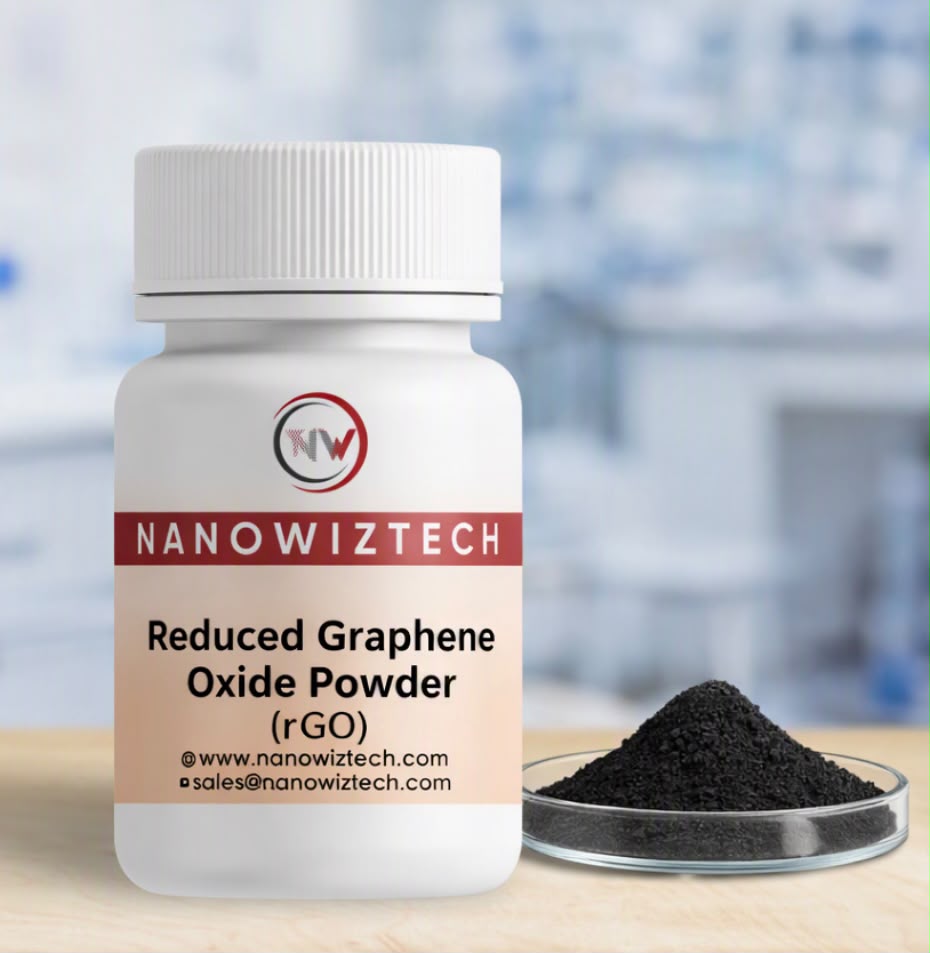
NanowizTech offers Reduced Graphene Oxide Powder (rGO) for advanced materials research, nanotechnology development, and industrial applications. Reduced graphene oxide is a graphene-derived carbon nanomaterial attracting interest across scientific and industrial sectors because of its electrical, structural, thermal, and surface properties. It is used in research and product development involving conductive coatings, composite materials, energy storage systems, sensors, functional films, and other advanced material technologies.
Product | Reduced Graphene Oxide Nanopowder | |
|---|---|---|
Stock No. | NW2001-01-106 | |
Purity | 99% | Confirm |
Thickness | 0.5-0.6nm | Confirm |
Form | Powder | Confirm |
Color | Black | Confirm |
Density | 1.91 g/cm3 | Confirm |
Electrical Conductivity | 6667 S/m(*) | Confirm |
Reduction method | Chemically reduced | Confirm |
Dispersibility | NMP, DMSO,DMF | Confirm |
Humidity (Karl Fisher) | 3.7 - 4.2 % | Confirm |
BET surface area | 422.69 – 499.85 m2/g | Confirm |
Solubility | Insoluble in water | Confirm |
Main Inspect Verifier | QC In charge | Confirm |
Note: Product Specification are subject to amendment and may change over time.
NanoWizTech Largest Reduced Graphene Oxide Manufacturer:
NanowizTech serves customers searching for a Reduced Graphene Oxide Powder manufacturer and supplier for research, development, and industrial use. As demand for graphene-based nanomaterials continues across advanced material technologies, selecting a supplier with clear product information and responsive technical support can help streamline material selection and procurement.
Reduced graphene oxide is not a single, perfectly uniform substance with identical properties across all suppliers. Its characteristics can vary according to the starting graphene oxide, reduction chemistry, processing conditions, washing procedures, drying methods, and post-treatment steps. For this reason, customers should evaluate the specific product grade rather than relying only on the general name rGO.
NanowizTech can present its available product documentation and commercial information to help customers determine whether a particular grade is appropriate for their intended use. Relevant details may include carbon and oxygen content, moisture level, ash content, particle or lateral sheet dimensions, layer characteristics, conductivity data, and analytical test results, where available.
Chemical Identification, Formula, and CAS Number:
Reduced graphene oxide is a carbon-based material derived from graphene oxide through a reduction process. Unlike a conventional small-molecule chemical, it does not have one universally fixed molecular formula because its composition depends on the degree of reduction, residual oxygen-containing groups, defects, and processing conditions.
Product identification:
- Product name: Reduced Graphene Oxide Powder
- Abbreviation: rGO
- Material category: Graphene-derived carbon nanomaterial
- Product form: Powder
- Formula or notation: rGO
- CAS number: 1034343-98-0, subject to confirmation against the supplier’s product documentation
- Supplier: NanowizTech
The notation rGO is a material abbreviation, not a conventional stoichiometric chemical formula. Reduced graphene oxide generally consists predominantly of carbon atoms arranged in graphene-related sheets, with variable amounts of oxygen and potentially other residual elements depending on its manufacturing process.
Customers requiring a formal chemical identity for procurement, regulatory documentation, or laboratory records should verify the CAS number and composition against the applicable product specification, technical data sheet, and safety data sheet. This is particularly important when different grades or production methods are involved.
High-Purity Reduced Graphene Oxide Powder
Purity is an important consideration when selecting Reduced Graphene Oxide Powder for demanding research and industrial applications. Depending on the intended use, customers may need information about carbon content, residual oxygen, inorganic impurities, moisture, ash content, and other compositional characteristics.
High-purity rGO can be relevant to applications in which unwanted contaminants may influence electrical performance, electrochemical behavior, surface chemistry, composite compatibility, or experimental reproducibility. However, the term “high purity” should be linked to a defined specification or verified test result rather than used as an unsupported universal claim.
When evaluating high-purity Reduced Graphene Oxide Powder, customers may request:
- Carbon and oxygen composition data.
- Moisture and ash content.
- Residual elemental impurity analysis, where available.
- Raman spectroscopy results for structural characterization.
- X-ray photoelectron spectroscopy (XPS) data for surface composition.
Properties of Reduced Graphene Oxide Powder
Reduced graphene oxide is widely investigated because its structure and surface chemistry can be adjusted through manufacturing and post-processing. Its properties vary by grade, and actual values should be obtained from the supplier’s product data.
Electrical Conductivity
One of the major reasons for researching rGO is its potential for electrical conduction. The reduction process removes some oxygen-containing groups and can partially restore the conjugated carbon network. This can improve charge transport compared with unreduced graphene oxide.
Electrical performance depends on reduction conditions, defects, residual oxygen, flake dimensions, compaction, film formation, contact resistance, and measurement methods. Consequently, conductivity should be evaluated using product-specific data rather than assumed from the material name alone.
High Surface Area
Graphene-derived sheets can provide substantial accessible surface area, depending on their morphology and degree of aggregation. This characteristic is relevant to electrode development, adsorption studies, sensing research, and functional composite design.
Actual accessible surface area depends on the degree of restacking, porosity, drying method, and processing conditions. Buyers should consult measured data when surface area is a critical design parameter.
Thermal Characteristics
The carbon-rich structure of reduced graphene oxide makes it relevant to investigations involving heat transfer, thermal management, and functional composites. Its contribution to thermal performance depends on material quality, orientation, dispersion, contact between sheets, and the properties of the surrounding matrix.
Mechanical Reinforcement Potential
rGO is studied as an additive in polymers, coatings, and composite materials. When properly dispersed and compatible with the matrix, graphene-derived sheets may contribute to mechanical reinforcement or changes in barrier and functional properties.
Performance is influenced by loading level, interfacial bonding, sheet dimensions, processing methods, and dispersion quality. The effect must be established for the particular formulation.
Surface Chemistry
Residual oxygen-containing functional groups can influence wettability, dispersion, chemical interactions, and compatibility with other materials. The concentration of these groups varies with the degree of reduction and the production method.
Lightweight Carbon-Based Structure
Reduced graphene oxide is investigated for applications where a graphene-derived carbon material can provide useful functional properties without requiring a large quantity of additive. The overall performance of the finished product depends on formulation, processing, and application-specific design requirements.
Applications of Reduced Graphene Oxide Powder
Reduced Graphene Oxide Powder is researched and used in a range of advanced material development programs. Its suitability depends on the material grade, dispersion, formulation, and performance requirements.
Energy Storage and Battery Research
rGO is investigated as a conductive component in electrode formulations and other energy-storage materials. Its graphene-derived structure may help form conductive pathways within an electrode when appropriately processed.
Research areas include lithium-ion battery electrodes, sodium-ion battery materials, supercapacitors, hybrid energy-storage systems, and electrochemical composite development. Performance depends on electrode composition, surface chemistry, porosity, conductivity, and manufacturing conditions.
Supercapacitors and Electrochemical Devices
The surface characteristics and electrical behavior of rGO make it relevant to supercapacitor and electrochemical research. Material structure, accessible surface area, electrode architecture, and interactions with other active materials can influence measured performance.
Researchers may use rGO as a conductive network, a component of hybrid electrode materials, or a platform for additional surface modification.
Conductive Coatings and Inks
Reduced graphene oxide is studied for conductive coatings, functional inks, and thin-film development. Its performance depends on dispersion stability, binder selection, film thickness, coating process, and the electrical connections formed during drying or curing.
Potential development areas include flexible electronics, antistatic layers, functional surfaces, and printed electronic materials. Specific applications require evaluation of conductivity, adhesion, flexibility, and environmental stability.
Sensors and Detection Technologies
Graphene-derived materials are investigated in sensor systems because their electrical and surface properties can respond to interactions with surrounding substances. rGO may be incorporated into chemical sensors, gas-sensing materials, electrochemical sensors, and experimental biosensor platforms.
Sensitivity and selectivity depend on device design, surface functionalization, target analyte, operating conditions, and calibration. The performance of any particular sensor must be established experimentally.
Polymer Composites
rGO can be incorporated into polymer matrices to investigate changes in electrical, mechanical, thermal, and barrier properties. Potential matrix systems include selected thermoplastics, thermosetting resins, elastomers, and specialty polymer formulations.
The degree of dispersion and compatibility between rGO and the polymer is critical. Agglomeration, loading level, and processing conditions may substantially affect the final properties.
Corrosion Protection and Functional Coatings
Graphene-derived materials are studied as additives in protective coating systems. Depending on the coating formulation, they may contribute to barrier performance or modify electrical and mechanical characteristics.
Actual corrosion resistance depends on the substrate, coating chemistry, film integrity, dispersion, defects, and exposure conditions. Suitability should be confirmed through application-specific testing.
Water Treatment and Adsorption Research
Modified graphene-derived materials are investigated for interactions with selected contaminants and for use in experimental adsorption and water-treatment systems. Surface functional groups, porosity, modification chemistry, and the composition of the water influence performance.
For practical treatment systems, recovery, regeneration, stability, and environmental considerations must also be evaluated.
Research and Academic Laboratories
Universities and research institutes use reduced graphene oxide in studies involving carbon nanomaterials, surface science, electrochemistry, composite design, functional coatings, and nanoscale material characterization.
Bulk Orders and Industrial Supply
Bulk purchasing can help research organizations and manufacturers coordinate material procurement across multiple development stages. However, the appropriate order size depends on the application, material consumption, storage conditions, and required quality controls.
Before ordering larger quantities of Reduced Graphene Oxide Powder, buyers should confirm the following details:
- Required grade and technical specification.
- Available quantity and order lead time.
- Packaging size and storage conditions.
- Batch identification and traceability.
- Quality documents available for each order.
- Shipping method and destination.
- Commercial terms and repeat-order requirements.
Why NanowizTech for Reduced Graphene Oxide Powder?
Choosing a supplier for graphene-derived materials involves more than finding a product listing. Buyers need clear communication, useful technical information, suitable commercial terms, and a realistic understanding of the material’s properties.
Customers considering NanowizTech for rGO powder can inquire about:
Product information: Request available specifications and details about the grade most appropriate for your intended application.
Quality documentation: Ask about certificates of analysis, technical data sheets, safety data sheets, and other documents available for the product.
Application requirements: Share your intended use and key performance criteria to help identify relevant product characteristics.
Commercial quotations: Request pricing based on the required grade, quantity, packaging, and destination.
International orders: Confirm shipping options, export documentation, and delivery estimates for your location.
Procurement support: Discuss availability, packaging, and repeat-order requirements before committing to a larger purchase.
The suitability of a particular rGO grade should always be determined by its documented properties and the requirements of the intended application.