Titanium Dioxide Nanoparticles Dispersion -High Purity
High purtiy 99.9%, Global Shipping, CAS No 1317-80-2, Water based-Colloidal Dispersion (Customized)
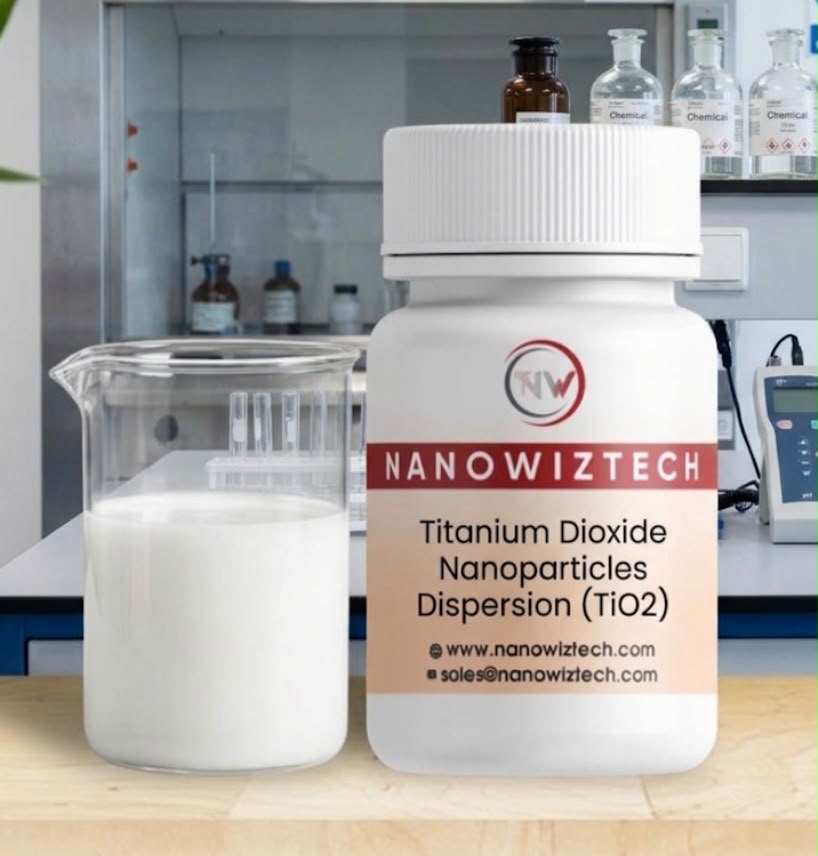
NanowizTech offers Titanium Dioxide (TiO₂) Nanoparticles Dispersion for advanced material development, research, and industrial applications. Titanium dioxide is an important inorganic material valued for its optical properties, chemical stability, and versatility across a range of technology-driven industries. CAS No. of TiO2 1317-80-2 high purity nanodispersion.
Product | Titanium Dioxide Nanoparticles Dispersion | |
|---|---|---|
Stock No. | NW3205-08-134 | |
CAS | 1317-80-2 | Confirm |
Purity | 99.9% | Confirm |
Formula | TiO2 | Confirm |
Concentration | 1000ppm, 5Wt%,20wt%, 30wt% (customized) | Confirm |
APS | 20-50nm | Confirm |
Color | White | Confirm |
Density | ~ 1.2/cm3 | Confirm |
Form | Liquid | Confirm |
pH | 7 | Confirm |
Solvent | Water(ddH20), IPA, Ethanol (as per requirement) | Confirm |
Main Inspect Verifier | QC In charge | Confirm |
Note: Product Specification are subject to amendment and may change over time.
NanowizTech Titanium Dioxide Nanoparticle Dispersion – High-Purity TiO₂ Nanoparticles Manufacturer and Global Supplier
NanowizTech Titanium Dioxide Nanoparticle Dispersion
NanowizTech Titanium Dioxide Nanoparticle Dispersion is designed for industrial, scientific, research, and advanced material applications that require the unique optical, chemical, and functional properties of titanium dioxide. Titanium dioxide, commonly known as TiO₂, is a widely used inorganic material valued for its whiteness, refractive index, UV absorption characteristics, chemical stability, and versatility across numerous industries.
As demand for advanced nanomaterials continues to grow, titanium dioxide nanoparticles are becoming increasingly important in coatings, paints, plastics, textiles, cosmetics, ceramics, construction materials, photocatalytic systems, and research laboratories. Their nanoscale dimensions can provide distinctive surface characteristics and functional performance compared with conventional titanium dioxide powders, depending on particle size, crystal structure, surface treatment, concentration, and dispersion quality.
NanowizTech aims to support customers seeking titanium dioxide nanoparticle dispersion solutions for product development, industrial processing, and specialized material formulations. Whether you are a manufacturer, research institution, laboratory, distributor, or industrial procurement professional, selecting the appropriate TiO₂ dispersion is an important step toward achieving consistent product performance.
For businesses looking for a titanium dioxide nanoparticles manufacturer, TiO₂ dispersion supplier, or wholesale nanomaterials source, NanowizTech offers a product-focused approach centered on material specifications, application requirements, and customer needs.
Titanium Dioxide Nanoparticles: Chemical Information
Titanium dioxide is an inorganic compound composed of titanium and oxygen. It occurs naturally in several crystalline forms and is commercially produced for a broad range of industrial applications.
Chemical and product identification
- Product name: Titanium Dioxide Nanoparticle Dispersion
- Chemical name: Titanium dioxide
- Chemical formula: TiO₂
- CAS number: 1317-80-2 (rutile titanium dioxide)
- Alternative name: Titanium(IV) oxide
- Material category: Inorganic oxide nanomaterial
- Common crystal structures: Rutile, anatase, and brookite
- Appearance: Depends on formulation, particle characteristics, concentration, and dispersion medium
- Product form: Liquid nanoparticle dispersion, subject to the actual supplied specification
- Main functional characteristics: Optical performance, UV interaction, chemical stability, and surface-related properties
What Is Titanium Dioxide Nanoparticle Dispersion?
Titanium dioxide nanoparticle dispersion is a formulated system in which nanoscale TiO₂ particles are distributed throughout a liquid medium. Depending on the product, the medium may be water, an organic solvent, or another compatible formulation system.
A well-designed dispersion helps make nanoparticles easier to handle, measure, mix, and incorporate into manufacturing processes than a dry powder in applications where liquid processing is preferred. Dispersion quality can influence coating uniformity, optical characteristics, surface coverage, processing stability, and final product performance.
Nanoparticle dispersion is not defined solely by the chemical composition of TiO₂. Important characteristics also include the primary particle size, aggregate size, particle-size distribution, solid content, pH, viscosity, surface chemistry, and long-term storage stability.
For this reason, buyers should select titanium dioxide nanoparticle dispersion according to the requirements of their intended application rather than relying on the chemical name alone.
NanowizTech Titanium Dioxide Nanoparticle Dispersion is intended for customers evaluating advanced TiO₂ materials for industrial formulation, materials research, and application-specific development. Product selection should be based on the current technical data sheet and confirmation of compatibility with the intended manufacturing process.
Key Properties of Titanium Dioxide Nanoparticles Dispersion
High Refractive Index
Titanium dioxide is known for its high refractive index compared with many other common inorganic materials. This optical characteristic makes TiO₂ useful in coatings, optical formulations, pigments, and materials that require control over light scattering.
The actual optical performance of a nanoparticle dispersion depends on particle size, aggregation, concentration, surface treatment, and the refractive indices of the surrounding medium and final formulation.
UV Absorption Characteristics
Titanium dioxide interacts with ultraviolet radiation because of its electronic and optical properties. Depending on particle size, crystal structure, coating, and formulation, TiO₂ nanoparticles can be used in selected UV-management and protective material applications.
UV-related performance should be established through suitable testing rather than assumed from the chemical composition alone.
Chemical Stability
Titanium dioxide is valued for its chemical stability under many ordinary application conditions. This characteristic contributes to its use in coatings, ceramics, construction materials, and other engineered formulations.
However, compatibility can vary with the surrounding chemicals, pH, temperature, surface modification, and processing environment.
High Surface Area
Nanoparticles may offer a greater specific surface area than larger particles of the same material. This can influence adsorption, interfacial interactions, catalytic activity, and compatibility with other formulation ingredients.
The surface area of a particular TiO₂ grade should be confirmed using an appropriate measurement method, such as BET analysis where applicable.
Photocatalytic Properties
Certain titanium dioxide nanoparticle grades, particularly selected anatase-containing materials, can demonstrate photocatalytic activity under suitable illumination conditions. These properties have attracted interest in environmental technologies, self-cleaning surfaces, and experimental degradation processes.
Photocatalytic activity is highly dependent on crystal structure, surface characteristics, illumination, and reaction conditions. It should not be assumed that every TiO₂ dispersion has the same activity.
Whiteness and Optical Performance
Conventional titanium dioxide is widely used in applications that require whiteness, opacity, and light scattering. At the nanoscale, optical behavior can differ from that of conventional pigment-grade particles.
Consequently, nano-TiO₂ should not automatically be considered a direct substitute for standard pigment-grade titanium dioxide. The intended optical effect and required particle characteristics should guide product selection.
Applications of Titanium Dioxide Nanoparticle Dispersion
Paints and Industrial Coatings
Titanium dioxide is an important material in the coatings industry because of its optical characteristics and stability. Nanoparticle dispersions may be investigated for functional coatings, surface modification, UV-related performance, and specialized formulations.
Potential areas of evaluation include:
- Protective and functional coatings
- Industrial surface treatments
- Selected architectural coating formulations
- UV-interacting coating systems
- Research into advanced coating technologies
The suitability of a nanoparticle dispersion depends on its compatibility with the resin, solvent, additives, and curing conditions. Conventional pigment opacity and nano-scale functional performance are not necessarily interchangeable.
Plastics and Polymer Materials
TiO₂ materials are used in plastics and polymer-based products for optical, functional, and surface-related purposes. Selected nanoparticle dispersions may be evaluated in compatible polymer systems or applied as functional surface treatments.
Potential development areas include polymer coatings, specialty plastics, composite materials, and experimental UV-management formulations.
Before incorporation into a polymer, manufacturers should assess dispersion compatibility, thermal stability, aggregation, and the effects on mechanical and optical properties.
Textile and Fabric Applications
Titanium dioxide nanomaterials are investigated for specialized textile finishing and functional fabric treatments. Depending on the formulation, researchers may evaluate their contribution to UV-related performance, photocatalytic functionality, and surface characteristics.
Potential applications include:
- Functional textile coatings
- Specialty fabric finishing
- Research into self-cleaning surfaces
- Development of selected UV-management textile treatments
Testing should consider fabric durability, wash resistance, particle retention, user exposure, and environmental release.
Cosmetics and Personal Care Formulations
Titanium dioxide is used in certain cosmetic and personal care products, including some sunscreen formulations. However, cosmetic suitability is highly dependent on regulatory requirements, particle characteristics, surface treatment, purity, and the product’s intended use.
A general-purpose industrial nanoparticle dispersion must not automatically be considered suitable for cosmetics, sunscreens, or direct skin contact.
Manufacturers should verify the relevant safety documentation, applicable regional regulations, permitted material specifications, and the suitability of the specific grade before considering any cosmetic application.
Photocatalysis and Environmental Research
Selected TiO₂ nanomaterials are studied for photocatalytic processes and environmental applications. Under appropriate illumination and reaction conditions, photocatalytically active titanium dioxide can participate in reactions involving certain organic compounds.
Research applications may include:
- Photocatalytic surface development
- Laboratory-scale pollutant degradation studies
- Functional construction materials
- Experimental self-cleaning coatings
- Advanced oxidation research
Performance depends on the grade, surface area, illumination, formulation, and experimental setup. Commercial or environmental performance should be established through appropriate testing.
Construction and Building Materials
Titanium dioxide materials are investigated in construction products, functional coatings, cementitious systems, and specialty surface treatments.
Potential development areas include architectural surfaces, functional building coatings, and research into photocatalytic construction materials.
The use of nanoparticles in cement, concrete, or coatings requires assessment of dispersion stability, material compatibility, durability, worker exposure, and environmental considerations.
Ceramics and Glass
TiO₂ has applications in ceramic materials, glass-related formulations, and selected functional surfaces. Depending on the intended process, titanium dioxide may be studied for its influence on optical properties, material composition, and surface functionality.
Manufacturers should confirm the particle characteristics and compatibility of the dispersion with their processing temperatures, binders, and raw materials.
Paper and Specialty Materials
Titanium dioxide is used in selected paper, coating, and specialty material applications where optical or functional characteristics are important. Nanoparticle dispersions may be explored in research and specialized surface treatments.
The required grade will depend on opacity, whiteness, surface properties, formulation stability, and processing requirements.
Research Laboratories and Nanotechnology
Research institutions use TiO₂ nanomaterials to investigate particle behavior, surface chemistry, optical response, photocatalysis, and composite materials.
NanowizTech titanium dioxide nanoparticle dispersion may be evaluated for research projects when its verified specifications match the experiment’s requirements.
Researchers should confirm the crystal phase, concentration, particle size, solvent, pH, and storage conditions before beginning experimental work.
Advanced Materials Development
Titanium dioxide nanoparticles are also studied in emerging materials technologies, including specialized surface engineering, functional composites, and selected optical or electronic research systems.
The precise suitability of any dispersion depends on its purity, composition, reproducibility, and performance under the intended operating conditions.
High-Purity Titanium Dioxide Nanoparticles
Purity is an important consideration when purchasing titanium dioxide nanoparticles for research, industrial manufacturing, and specialized applications. The appropriate purity requirement depends on the process, final product, and acceptable levels of impurities.
High-purity TiO₂ can be relevant to applications where unwanted contaminants may affect optical performance, surface chemistry, catalytic behavior, or material consistency.
When evaluating a titanium dioxide nanoparticle supplier, buyers should request relevant documentation, including:
- TiO₂ content or assay
- Trace impurity profile, where applicable
- Crystal phase identification
- Particle-size information and measurement method
- Specific surface area, if relevant
- Dispersion medium and solids concentration
NanowizTech Titanium Dioxide Nanoparticle Dispersion – High-Purity TiO₂ Nanoparticles Manufacturer and Global Supplier
Introduction to NanowizTech Titanium Dioxide Nanoparticle Dispersion
NanowizTech Titanium Dioxide Nanoparticle Dispersion is designed for industrial, scientific, research, and advanced material applications that require the unique optical, chemical, and functional properties of titanium dioxide. Titanium dioxide, commonly known as TiO₂, is a widely used inorganic material valued for its whiteness, refractive index, UV absorption characteristics, chemical stability, and versatility across numerous industries.
As demand for advanced nanomaterials continues to grow, titanium dioxide nanoparticles are becoming increasingly important in coatings, paints, plastics, textiles, cosmetics, ceramics, construction materials, photocatalytic systems, and research laboratories. Their nanoscale dimensions can provide distinctive surface characteristics and functional performance compared with conventional titanium dioxide powders, depending on particle size, crystal structure, surface treatment, concentration, and dispersion quality.
NanowizTech aims to support customers seeking titanium dioxide nanoparticle dispersion solutions for product development, industrial processing, and specialized material formulations. Whether you are a manufacturer, research institution, laboratory, distributor, or industrial procurement professional, selecting the appropriate TiO₂ dispersion is an important step toward achieving consistent product performance.
For businesses looking for a titanium dioxide nanoparticles manufacturer, TiO₂ dispersion supplier, or wholesale nanomaterials source, NanowizTech offers a product-focused approach centered on material specifications, application requirements, and customer needs.
Titanium Dioxide Nanoparticles: Chemical Information
Titanium dioxide is an inorganic compound composed of titanium and oxygen. It occurs naturally in several crystalline forms and is commercially produced for a broad range of industrial applications.
Chemical and product identification
- Product name: Titanium Dioxide Nanoparticle Dispersion
- Chemical name: Titanium dioxide
- Chemical formula: TiO₂
- CAS number: 1317-80-2 (rutile titanium dioxide)
- Alternative name: Titanium(IV) oxide
- Material category: Inorganic oxide nanomaterial
- Common crystal structures: Rutile, anatase, and brookite
- Appearance: Depends on formulation, particle characteristics, concentration, and dispersion medium
- Product form: Liquid nanoparticle dispersion, subject to the actual supplied specification
- Main functional characteristics: Optical performance, UV interaction, chemical stability, and surface-related properties
The CAS number should be verified against the precise crystalline form and material identity offered. CAS No. 1317-80-2 is associated with rutile titanium dioxide; anatase and other forms may have different identifiers.
What Is Titanium Dioxide Nanoparticle Dispersion?
Titanium dioxide nanoparticle dispersion is a formulated system in which nanoscale TiO₂ particles are distributed throughout a liquid medium. Depending on the product, the medium may be water, an organic solvent, or another compatible formulation system.
A well-designed dispersion helps make nanoparticles easier to handle, measure, mix, and incorporate into manufacturing processes than a dry powder in applications where liquid processing is preferred. Dispersion quality can influence coating uniformity, optical characteristics, surface coverage, processing stability, and final product performance.
Nanoparticle dispersion is not defined solely by the chemical composition of TiO₂. Important characteristics also include the primary particle size, aggregate size, particle-size distribution, solid content, pH, viscosity, surface chemistry, and long-term storage stability.
For this reason, buyers should select titanium dioxide nanoparticle dispersion according to the requirements of their intended application rather than relying on the chemical name alone.
NanowizTech Titanium Dioxide Nanoparticle Dispersion is intended for customers evaluating advanced TiO₂ materials for industrial formulation, materials research, and application-specific development. Product selection should be based on the current technical data sheet and confirmation of compatibility with the intended manufacturing process.
Key Properties of Titanium Dioxide Nanoparticles
1. High Refractive Index
Titanium dioxide is known for its high refractive index compared with many other common inorganic materials. This optical characteristic makes TiO₂ useful in coatings, optical formulations, pigments, and materials that require control over light scattering.
The actual optical performance of a nanoparticle dispersion depends on particle size, aggregation, concentration, surface treatment, and the refractive indices of the surrounding medium and final formulation.
2. UV Absorption Characteristics
Titanium dioxide interacts with ultraviolet radiation because of its electronic and optical properties. Depending on particle size, crystal structure, coating, and formulation, TiO₂ nanoparticles can be used in selected UV-management and protective material applications.
UV-related performance should be established through suitable testing rather than assumed from the chemical composition alone.
3. Chemical Stability
Titanium dioxide is valued for its chemical stability under many ordinary application conditions. This characteristic contributes to its use in coatings, ceramics, construction materials, and other engineered formulations.
However, compatibility can vary with the surrounding chemicals, pH, temperature, surface modification, and processing environment.
4. High Surface Area
Nanoparticles may offer a greater specific surface area than larger particles of the same material. This can influence adsorption, interfacial interactions, catalytic activity, and compatibility with other formulation ingredients.
The surface area of a particular TiO₂ grade should be confirmed using an appropriate measurement method, such as BET analysis where applicable.
5. Photocatalytic Properties
Certain titanium dioxide nanoparticle grades, particularly selected anatase-containing materials, can demonstrate photocatalytic activity under suitable illumination conditions. These properties have attracted interest in environmental technologies, self-cleaning surfaces, and experimental degradation processes.
Photocatalytic activity is highly dependent on crystal structure, surface characteristics, illumination, and reaction conditions. It should not be assumed that every TiO₂ dispersion has the same activity.
6. Whiteness and Optical Performance
Conventional titanium dioxide is widely used in applications that require whiteness, opacity, and light scattering. At the nanoscale, optical behavior can differ from that of conventional pigment-grade particles.
Consequently, nano-TiO₂ should not automatically be considered a direct substitute for standard pigment-grade titanium dioxide. The intended optical effect and required particle characteristics should guide product selection.
7. Versatile Formulation Potential
Titanium dioxide nanoparticle dispersions can be incorporated into compatible liquid formulations for research and industrial processing. Depending on the product’s composition, they may be evaluated in waterborne coatings, functional surface treatments, polymer systems, and specialized formulations.
Compatibility testing is recommended before production-scale use.
Applications of Titanium Dioxide Nanoparticle Dispersion
1. Paints and Industrial Coatings
Titanium dioxide is an important material in the coatings industry because of its optical characteristics and stability. Nanoparticle dispersions may be investigated for functional coatings, surface modification, UV-related performance, and specialized formulations.
Potential areas of evaluation include:
- Protective and functional coatings
- Industrial surface treatments
- Selected architectural coating formulations
- UV-interacting coating systems
- Research into advanced coating technologies
The suitability of a nanoparticle dispersion depends on its compatibility with the resin, solvent, additives, and curing conditions. Conventional pigment opacity and nano-scale functional performance are not necessarily interchangeable.
2. Plastics and Polymer Materials
TiO₂ materials are used in plastics and polymer-based products for optical, functional, and surface-related purposes. Selected nanoparticle dispersions may be evaluated in compatible polymer systems or applied as functional surface treatments.
Potential development areas include polymer coatings, specialty plastics, composite materials, and experimental UV-management formulations.
Before incorporation into a polymer, manufacturers should assess dispersion compatibility, thermal stability, aggregation, and the effects on mechanical and optical properties.
3. Textile and Fabric Applications
Titanium dioxide nanomaterials are investigated for specialized textile finishing and functional fabric treatments. Depending on the formulation, researchers may evaluate their contribution to UV-related performance, photocatalytic functionality, and surface characteristics.
Potential applications include:
- Functional textile coatings
- Specialty fabric finishing
- Research into self-cleaning surfaces
- Development of selected UV-management textile treatments
Testing should consider fabric durability, wash resistance, particle retention, user exposure, and environmental release.
4. Cosmetics and Personal Care Formulations
Titanium dioxide is used in certain cosmetic and personal care products, including some sunscreen formulations. However, cosmetic suitability is highly dependent on regulatory requirements, particle characteristics, surface treatment, purity, and the product’s intended use.
A general-purpose industrial nanoparticle dispersion must not automatically be considered suitable for cosmetics, sunscreens, or direct skin contact.
Manufacturers should verify the relevant safety documentation, applicable regional regulations, permitted material specifications, and the suitability of the specific grade before considering any cosmetic application.
5. Photocatalysis and Environmental Research
Selected TiO₂ nanomaterials are studied for photocatalytic processes and environmental applications. Under appropriate illumination and reaction conditions, photocatalytically active titanium dioxide can participate in reactions involving certain organic compounds.
Research applications may include:
- Photocatalytic surface development
- Laboratory-scale pollutant degradation studies
- Functional construction materials
- Experimental self-cleaning coatings
- Advanced oxidation research
Performance depends on the grade, surface area, illumination, formulation, and experimental setup. Commercial or environmental performance should be established through appropriate testing.
6. Construction and Building Materials
Titanium dioxide materials are investigated in construction products, functional coatings, cementitious systems, and specialty surface treatments.
Potential development areas include architectural surfaces, functional building coatings, and research into photocatalytic construction materials.
The use of nanoparticles in cement, concrete, or coatings requires assessment of dispersion stability, material compatibility, durability, worker exposure, and environmental considerations.
7. Ceramics and Glass
TiO₂ has applications in ceramic materials, glass-related formulations, and selected functional surfaces. Depending on the intended process, titanium dioxide may be studied for its influence on optical properties, material composition, and surface functionality.
Manufacturers should confirm the particle characteristics and compatibility of the dispersion with their processing temperatures, binders, and raw materials.
8. Paper and Specialty Materials
Titanium dioxide is used in selected paper, coating, and specialty material applications where optical or functional characteristics are important. Nanoparticle dispersions may be explored in research and specialized surface treatments.
The required grade will depend on opacity, whiteness, surface properties, formulation stability, and processing requirements.
9. Research Laboratories and Nanotechnology
Research institutions use TiO₂ nanomaterials to investigate particle behavior, surface chemistry, optical response, photocatalysis, and composite materials.
NanowizTech titanium dioxide nanoparticle dispersion may be evaluated for research projects when its verified specifications match the experiment’s requirements.
Researchers should confirm the crystal phase, concentration, particle size, solvent, pH, and storage conditions before beginning experimental work.
10. Advanced Materials Development
Titanium dioxide nanoparticles are also studied in emerging materials technologies, including specialized surface engineering, functional composites, and selected optical or electronic research systems.
The precise suitability of any dispersion depends on its purity, composition, reproducibility, and performance under the intended operating conditions.
Why Choose NanowizTech for Titanium Dioxide Nanoparticle Dispersion?
Selecting a reliable supplier is an important part of maintaining consistent production, research quality, and procurement efficiency. Buyers should consider technical documentation, product suitability, order quantities, communication, and delivery capabilities when comparing nanomaterial suppliers.
Application-Oriented Product Selection
Different industries require different TiO₂ properties. Selecting a suitable dispersion involves understanding the intended application, processing conditions, compatibility requirements, and expected performance.
NanowizTech can present product specifications and application information to help prospective customers determine whether an offered grade is appropriate for their requirements.
Quality and Technical Documentation
Technical documentation helps customers evaluate product consistency and suitability. Before placing an order, request the applicable technical data sheet, certificate of analysis, safety data sheet, and any available particle characterization information.
Documentation should relate to the actual product grade and batch being supplied.
Competitive and Cost-Effective Pricing
Industrial customers often compare titanium dioxide nanoparticle prices across suppliers to balance material performance and procurement costs.
NanowizTech can position its offering around competitive pricing where supported by current quotations. The final price may depend on particle size, purity, solids content, dispersion medium, order quantity, packaging, testing requirements, and shipping destination.
For an accurate quotation, buyers should specify the required grade, quantity, delivery country, and intended application.
Bulk and Wholesale Supply
Industrial manufacturers and distributors may require regular supplies or larger order quantities. Bulk purchasing can help streamline procurement when the selected grade is suitable for the customer’s manufacturing process.
Available packaging sizes, minimum order quantities, lead times, and bulk pricing should be confirmed directly with NanowizTech.
Global Shipping and International Supply
International buyers may require titanium dioxide nanoparticle dispersion for research, product development, and industrial manufacturing.
Global shipping availability depends on the destination, order size, packaging requirements, transport regulations, and the nature of the dispersion medium. Customers should confirm shipping coverage, delivery estimates, export documentation, customs requirements, and applicable handling restrictions before ordering.
NanowizTech’s international supply capabilities should be confirmed for the specific destination and product configuration.
Support for Industrial and Research Buyers
A clear specification helps suppliers identify the most suitable product and helps buyers avoid unnecessary material substitutions.
When contacting NanowizTech, provide information about the intended application, target particle size, required purity, preferred dispersion medium, expected order quantity, and any relevant regulatory or testing requirements.
Titanium Dioxide Nanoparticle Dispersion Price
The price of titanium dioxide nanoparticle dispersion varies according to the technical characteristics of the material and the commercial requirements of the order.
Factors that may influence the final quotation include:
- Particle size and particle-size distribution
- Titanium dioxide purity and impurity limits
- Solid content and concentration
- Rutile, anatase, or other specified crystal phase
- Water-based or solvent-based formulation
- Surface treatment or functionalization
- Packaging, storage, and handling requirements
- Order quantity and repeat-purchase volume
- Shipping destination, freight, and customs costs
- Testing, documentation, and regulatory requirements
For buyers searching online for titanium dioxide nanoparticles at a low price, the lowest quoted price may not provide the best overall value. Differences in solids content, aggregation, purity, stability, and application suitability can significantly affect actual usage costs.
Frequently Asked Questions About Titanium Dioxide Nanoparticles
What is titanium dioxide nanoparticle dispersion?
Titanium dioxide nanoparticle dispersion is a liquid formulation containing nanoscale TiO₂ particles distributed in a carrier medium. It is used or evaluated in research, coatings, functional materials, and other compatible industrial formulations.
What is the chemical formula of titanium dioxide?
The chemical formula of titanium dioxide is TiO₂, indicating one titanium atom and two oxygen atoms in each formula unit.
What is the CAS number of titanium dioxide?
CAS No. 1317-80-2 identifies rutile titanium dioxide. Buyers should verify the CAS number against the crystal phase and exact chemical identity of the product being purchased.
What are the main properties of TiO₂ nanoparticles?
Important properties may include a high refractive index, UV interaction, chemical stability, nanoscale surface characteristics, and photocatalytic behavior in suitable grades. The actual performance depends on the material’s composition and formulation.
What are the applications of titanium dioxide nanoparticle dispersion?
Potential applications include selected coatings, surface treatments, polymer research, textile finishing, ceramics, construction materials, photocatalysis, and nanotechnology research. Suitability must be established for the specific grade and process.
How can I get a competitive price for TiO₂ nanoparticles?
Request a quotation with the required particle size, purity, concentration, dispersion medium, quantity, and destination country. Comparing equivalent specifications is the best way to evaluate price and value.
Does NanowizTech offer global shipping?
International delivery depends on the destination, product formulation, packaging, and applicable shipping regulations. Contact NanowizTech to confirm service availability, estimated delivery times, and export requirements for your country.nt.
If you are searching for a titanium dioxide nanoparticle manufacturer, TiO₂ dispersion supplier, high-purity titanium dioxide, wholesale nanomaterials, competitive TiO₂ pricing, or international supply options, contact NanowizTech to request current product specifications and a quotation.
Request a quotation for NanowizTech Titanium Dioxide Nanoparticle Dispersion today. Share your required quantity, target specifications, application, and delivery destination to determine the appropriate product option for your needs