Iron Oxide Nanoparticles Dispersion -High Purity
High purtiy 99.9%, Global Shipping, CAS No 1309-37-1, Water based-Colloidal Dispersion (Customized)
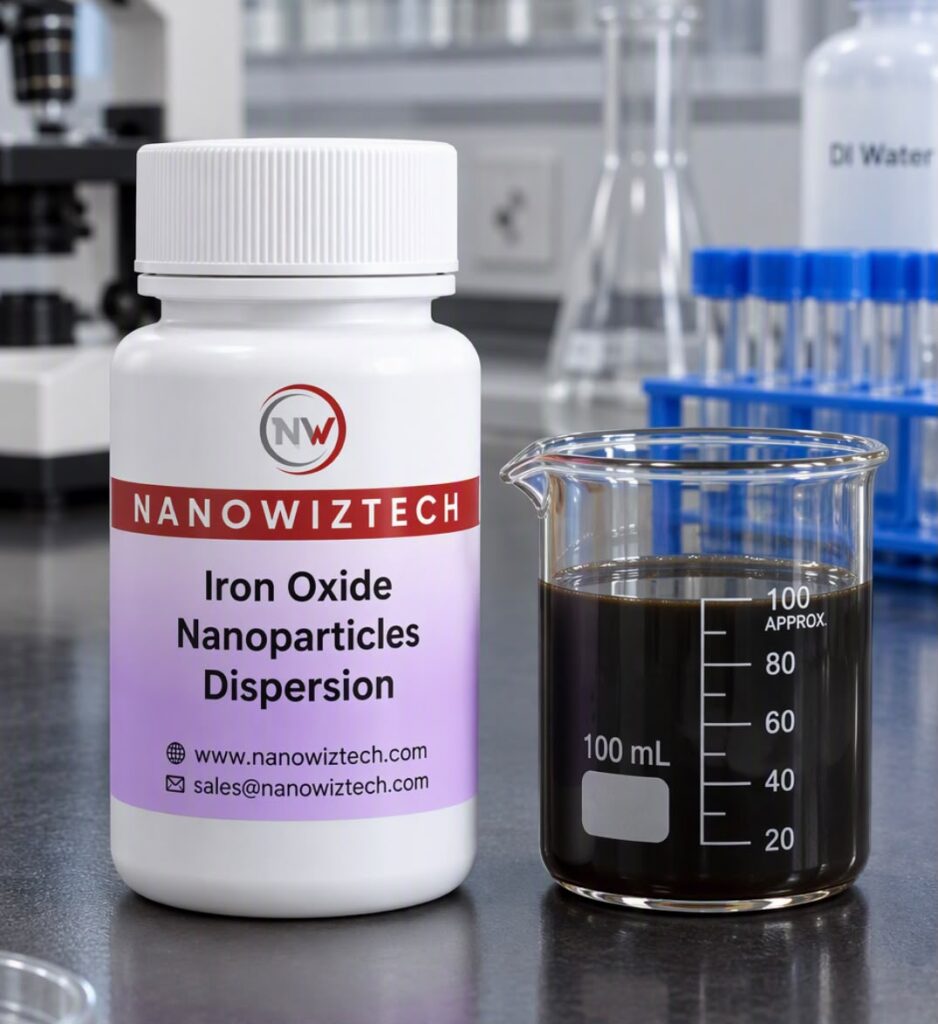
NanowizTech offers iron oxide nanoparticles nanodispersion for research, advanced materials development, and industrial nanotechnology applications. Iron oxide nanoparticles are valued for their distinctive magnetic properties, surface characteristics, and potential use in a range of scientific and engineering applications.
Product | Iron Oxide Nanoparticles Dispersion | |
|---|---|---|
Stock No. | NW3205-08-133 | |
CAS | 1309-37-1 | Confirm |
Purity | 99.9% | Confirm |
Formula | Fe2O3, Fe3O4 | Confirm |
Concentration | 1000ppm, 5Wt%,20wt% (customized) | Confirm |
APS | 20-30nm | Confirm |
Color | Black/ Brown red | Confirm |
Density | ~ 1.2/cm3 | Confirm |
pH | 7 | Confirm |
Solvent | Water(ddH20), (as per requirement) | Confirm |
Main Inspect Verifier | QC In charge | Confirm |
Note: Product Specification are subject to amendment and may change over time.
Iron Oxide Nanoparticles Nanodispersion Manufacturer and Supplier | NanowizTech
High-Purity Iron Oxide Nanoparticles Nanodispersion (Fe₂O₃)
NanowizTech Iron Oxide Nanoparticles Nanodispersion is designed for researchers, manufacturers, laboratories, and industrial customers seeking advanced iron oxide nanomaterials for research, product development, and specialized industrial applications. With a focus on material quality, technical specifications, competitive pricing, and international customer support, NanowizTech aims to serve customers looking for reliable iron oxide nanoparticle solutions.
Iron oxide nanoparticles are important functional nanomaterials used in materials science, coatings, pigments, catalysis, sensor development, environmental research, and other advanced technology applications. Their performance depends on particle size, crystal structure, surface chemistry, purity, concentration, and dispersion stability. Selecting the appropriate formulation helps researchers and manufacturers achieve consistent results in their intended applications.
NanowizTech offers iron oxide nanomaterial solutions for customers seeking application-specific specifications, convenient procurement, and global shipping options. Contact the technical sales team to discuss available nanodispersion formulations, purity requirements, particle-size ranges, packaging options, and bulk order pricing.
Whether you are developing a new coating, evaluating nanomaterials for laboratory research, or sourcing functional particles for industrial formulations, NanowizTech can help you identify the specifications required for your project.
what is Iron Oxide Nanoparticles Nanodispersion
Iron oxide nanoparticles are nanoscale particles composed of iron and oxygen. The Fe₂O₃ composition corresponds to iron(III) oxide, commonly known as ferric oxide. Depending on its crystal structure and preparation method, iron(III) oxide can exhibit different physical, chemical, optical, and surface properties.
An iron oxide nanoparticle nanodispersion consists of nanoparticles distributed throughout a liquid medium. Compared with handling dry nanopowder, a suitable liquid dispersion can simplify dosing, mixing, and incorporation into compatible formulations. The performance of a dispersion depends on the liquid carrier, particle concentration, surface treatment, particle-size distribution, and resistance to aggregation or settling.
NanowizTech Iron Oxide Nanoparticles Nanodispersion is intended for customers who need a liquid-form nanomaterial for research or formulation development. The exact composition and performance specifications should be selected according to the intended application.
Product name: Iron Oxide Nanoparticles Nanodispersion
Brand: NanowizTech
Chemical name: Iron(III) oxide, when the active material is confirmed as Fe₂O₃
Chemical formula: Fe₂O₃
CAS number: 1309-37-1 for iron(III) oxide
Common name: Ferric oxide
Product form: Liquid nanodispersion
Purity: Available specification to be confirmed with the supplier
Particle size: Application-specific; confirm the available specification
Dispersion medium: Confirm the selected formulation
Concentration: Confirm the product grade
Packaging: Subject to availability and order requirements
Shipping: International shipping options subject to destination, product classification, and applicable regulations
The specifications above should be finalized against the current NanowizTech technical data sheet and certificate of analysis before an order is placed.
NanowizTech: Iron Oxide Nanoparticles Manufacturer and Supplier
Choosing an appropriate nanomaterial supplier is an important step in research and industrial production. Customers require consistent specifications, transparent product information, dependable communication, and suitable purchasing options.
NanowizTech aims to support customers seeking iron oxide nanoparticles and nanodispersion products for specialized technical requirements. The objective is to help buyers identify a suitable material based on particle characteristics, chemical composition, dispersion properties, and end-use requirements.
Customers searching for an iron oxide nanoparticles manufacturer, iron oxide nanodispersion supplier, ferric oxide nanoparticles supplier, or high-purity Fe₂O₃ nanomaterial can contact NanowizTech to discuss their requirements.
Why Consider NanowizTech Iron Oxide Nanodispersion?
1. Application-focused material selection
Different industries require different nanoparticle properties. NanowizTech can discuss the parameters that matter for a proposed application, including particle size, purity, concentration, liquid carrier, and dispersion behavior.
2. High-purity material options
Purity is a key consideration in nanomaterial research and manufacturing. Customers can request available purity specifications and supporting analytical documentation. Actual purity should be verified using the relevant product specification and batch certificate.
3. Competitive pricing
NanowizTech aims to support cost-conscious purchasing through product-specific quotations and bulk-order discussions. Pricing may depend on concentration, purity, particle size, order quantity, packaging, and shipping destination. Contact the sales team for current pricing and volume-based quotations.
4. Technical specification support
Before purchasing, customers should confirm the chemical identity, CAS number, particle-size distribution, concentration, dispersion medium, and storage requirements. This helps reduce the risk of selecting a material that is unsuitable for the intended process.
5. Global customer reach
NanowizTech can discuss international shipping options for eligible destinations. Shipping availability, delivery estimates, customs documentation, and handling requirements depend on the destination country and the final product formulation.
6. Flexible purchasing discussions
Research laboratories, universities, product developers, and industrial buyers may have different order quantities and documentation requirements. Customers can inquire about available pack sizes, bulk procurement, and application-specific specifications.
NanowizTech should be described as the largest manufacturer only if that position is supported by independently verifiable industry data. Otherwise, phrases such as “iron oxide nanoparticles manufacturer and supplier,” “nanomaterial supply partner,” and “supplier of iron oxide nanodispersion” provide relevant SEO coverage without making an unsubstantiated market-leadership claim.
Chemical Properties of Iron Oxide Nanoparticles
Iron(III) oxide is an inorganic compound containing iron and oxygen. Its nanoscale form can provide a high surface-area-to-volume ratio relative to larger particles, making surface interactions particularly important in many applications.
The following properties are relevant when evaluating Fe₂O₃ nanoparticles.
Chemical Composition
The chemical formula of iron(III) oxide is Fe₂O₃. It contains iron in the +3 oxidation state and oxygen in the −2 oxidation state.
The molecular or formula mass is approximately 159.69 g/mol. The compound is commonly associated with ferric oxide and the mineral hematite, although nanoparticle formulations may contain different crystalline phases depending on their synthesis and processing.
Particle Size and Distribution
Particle size is a critical specification for nanomaterials. Smaller particles generally have a greater surface area relative to their mass, which can influence adsorption, reaction rates, optical behavior, and interactions with surrounding materials.
However, primary particle size is not necessarily the same as the size of particles or aggregates measured in a liquid dispersion. Buyers should distinguish between primary particle size, aggregate size, and hydrodynamic diameter.
For NanowizTech Iron Oxide Nanoparticles Nanodispersion, the appropriate particle-size specification should be confirmed for the selected grade.
Surface Area
Nanoparticles can offer a higher specific surface area than conventional bulk materials. This characteristic may be beneficial in catalytic systems, adsorbent development, surface-functionalization research, and composite materials.
The actual surface area depends on particle dimensions, morphology, porosity, and aggregation. A measured surface-area value should be obtained from the product’s technical documentation rather than assumed from its chemical formula.
Optical Properties
Iron(III) oxide can exhibit characteristic red, reddish-brown, and related colors, depending on its phase and physical characteristics. Its optical behavior can be relevant to pigment development, coatings, and materials research.
The appearance of a liquid nanodispersion may differ from that of a dry powder because of concentration, particle size, solvent properties, and light scattering.
Dispersion Stability
Dispersion stability is a particularly important consideration for liquid nanomaterials. Nanoparticles can aggregate or settle depending on their surface chemistry, concentration, carrier liquid, ionic strength, pH, and storage conditions.
A stable formulation helps improve dosing consistency and ease of incorporation into other materials. Nevertheless, long-term stability should be established through appropriate testing and should not be assumed for every Fe₂O₃ dispersion.
Magnetic Behavior
Iron oxide materials can have different magnetic characteristics depending on their composition and crystal structure. Fe₂O₃ phases, including hematite and maghemite, do not have identical magnetic properties. Magnetite, which has the formula Fe₃O₄, is a different iron oxide with distinct magnetic behavior.
Therefore, buyers requiring a particular magnetic response should verify the phase identity and measured magnetic properties rather than treating all iron oxide nanoparticles as interchangeable.
Applications of Iron Oxide Nanoparticles Nanodispersion
Iron oxide nanoparticles are investigated and used across a variety of research and industrial fields. Their suitability depends on the material’s verified properties and the requirements of the final formulation.
Advanced Coatings and Surface Engineering
Iron oxide nanoparticles can be investigated as functional components in coating systems and surface-engineering research. Depending on the formulation, they may contribute color, surface characteristics, or other material properties.
Researchers should evaluate compatibility with the coating resin, binder, solvent, and other additives. Dispersion quality and aggregation control are important for achieving uniform distribution.
Pigments and Color Formulations
Iron(III) oxide is widely associated with red and brown pigments. Iron oxide materials are used in pigment-related applications, including selected coatings, construction materials, and ceramic formulations.
Nanoscale materials may behave differently from conventional pigments in terms of dispersion, optical response, and processing. The suitability of a particular nanodispersion depends on its purity, particle characteristics, and formulation compatibility.
Catalysis Research
Iron oxide nanoparticles are investigated as catalyst materials and as components of catalytic systems. Their surface characteristics can be relevant to reactions involving oxidation and other chemical transformations.
The catalytic performance of a specific formulation depends on its phase, accessible surface area, surface chemistry, reaction conditions, and interaction with other components.
Researchers should evaluate the selected Fe₂O₃ material for the intended reaction instead of assuming that all iron oxide nanomaterials offer equivalent catalytic activity.
Environmental Research and Water Treatment
Iron oxide-based materials are studied for their interactions with selected dissolved species, contaminants, and other substances in aqueous environments.
Potential research areas include adsorption, surface modification, and the development of functional materials for water-treatment processes. Performance depends on the target contaminant, pH, competing ions, surface properties, and recovery method.
A specific iron oxide nanodispersion should be evaluated experimentally before use in a treatment process. Environmental suitability and disposal requirements must also be considered.
Sensors and Detection Technologies
Iron oxide nanomaterials are explored in sensor development and functional sensing systems. Their usefulness depends on the sensing mechanism and the material’s chemical, electrical, optical, or surface properties.
Research may involve gas-sensing materials, surface-functionalized systems, or composite structures. Sensor performance must be demonstrated through suitable calibration, selectivity, sensitivity, and stability testing.
Battery and Energy Materials Research
Iron oxide materials are investigated for selected energy-storage and electrochemical applications. Their suitability depends on phase composition, particle dimensions, surface properties, electrode formulation, and electrochemical behavior.
Researchers may examine Fe₂O₃-based materials in electrode development or composite formulations. The performance of a nanodispersion in an energy-storage system must be validated under the intended processing and testing conditions.
Ceramic and Glass Applications
Iron oxide compounds are used in various ceramic, glass, and materials-processing applications. Their effects depend on composition, concentration, processing temperature, and interactions with other ingredients.
Nanoscale iron oxide dispersions may be considered in selected formulation studies where controlled addition or uniform distribution is desirable. Compatibility and final product performance should be assessed experimentally.
Polymer Nanocomposites
Researchers investigate iron oxide nanoparticles as functional components of polymer composites. Incorporating nanoparticles into a polymer system requires attention to surface compatibility, viscosity, dispersion stability, and interfacial interactions.
A suitable dispersion can simplify material addition in some processes, provided that the carrier liquid is compatible with the polymer and does not adversely affect curing or final material properties.
Laboratory and Academic Research
Iron oxide nanoparticles are relevant to research in chemistry, nanotechnology, materials science, surface chemistry, and colloidal systems.
Universities and research laboratories may use characterized iron oxide materials to investigate particle behavior, surface modification, aggregation, optical response, or interactions with other materials.
Researchers should select the required crystal phase, purity, concentration, and particle-size range according to their experimental objectives.
Biomedical Materials Research
Iron oxide nanoparticles are studied in specialized biomedical and life-science research. However, biomedical suitability depends on formulation, particle composition, surface coating, biological compatibility, and applicable regulatory requirements.
An industrial or research-grade Fe₂O₃ nanodispersion should not be assumed to be suitable for human or veterinary use. Any proposed biomedical application requires appropriate characterization, safety assessment, and regulatory evaluation.
High-Purity Iron Oxide Nanodispersion for Research and Industry
Purity is one of the principal parameters to evaluate when purchasing iron oxide nanoparticles. Impurities can affect chemical reactivity, optical characteristics, surface behavior, and the reproducibility of experimental results.
For this reason, customers should request product-specific documentation describing the composition and relevant analytical measurements.
Important quality parameters include:
- Chemical identity and confirmed Fe₂O₃ composition.
- Iron oxide assay or purity.
- Crystal phase and structure, where applicable.
- Primary particle size and particle-size distribution.
- Concentration of nanoparticles in the liquid formulation.
- Dispersion medium and relevant solvent properties.
- pH, where applicable.
- Surface treatment or stabilizing agents, if used.
- Batch identification and certificate of analysis.
- Storage conditions and recommended handling procedures.
High purity should be stated only at the level demonstrated by the actual product specification. For example, a claim of 99.9% purity should be supported by the relevant analytical data and should clearly distinguish active-material purity from the total concentration of particles in the liquid dispersion.
NanowizTech customers can request the applicable technical data sheet and certificate of analysis to determine whether a selected grade meets their project requirements.
How to Select the Right Iron Oxide Nanodispersion
Selecting a nanodispersion requires more than identifying the chemical formula. A suitable product must meet the physical and chemical requirements of the intended process.
Confirm the chemical phase. Determine whether your application requires Fe₂O₃, Fe₃O₄, or another iron oxide material. These compounds are not interchangeable in every application.
Define the particle-size requirement. Specify the required primary particle size and, when relevant, the hydrodynamic size or aggregate-size distribution in the liquid.
Choose the concentration. Select a suitable solids concentration based on your formulation, dosing method, and intended use.
Check the dispersion medium. Confirm that the carrier liquid is compatible with your resin, solvent, aqueous system, or processing environment.
Evaluate stability. Assess settling, aggregation, viscosity, and storage stability under the conditions expected during transport and use.
Confirm pricing and shipping. Obtain a quotation based on the actual specification, order size, packaging, and delivery destination.
Following these steps helps buyers identify an iron oxide nanoparticle product that is better suited to their technical and commercial requirements.
Storage, Handling, and Quality Considerations
Proper handling is essential for maintaining nanomaterial quality and minimizing exposure.
Store the product according to the manufacturer’s instructions, including any requirements concerning temperature, light exposure, container closure, and shelf life. Before use, review the safety data sheet and confirm whether gentle mixing or another specified procedure is appropriate for restoring uniformity.
Do not assume that every iron oxide nanodispersion has the same stability or safety classification. Handling requirements depend on the nanoparticle formulation, carrier liquid, additives, concentration, and applicable regulations.
Avoid generating aerosols or allowing the material to dry into airborne dust during handling. Use appropriate laboratory or industrial controls and personal protective equipment based on the product-specific safety documentation.
For critical applications, establish incoming quality checks and verify that each batch meets the required specifications.
Why Choose NanowizTech Specialized Iron Oxide Nanoparticle Supplier?
Working with a supplier that understands nanomaterial specifications can help streamline product selection and procurement. The most useful supplier relationship combines clear technical communication with suitable documentation and realistic commercial terms.
NanowizTech aims to support customers looking for Fe₂O₃ nanodispersion by discussing material requirements, available specifications, purchasing quantities, and shipping arrangements.
Customers can request information about:
- Iron oxide nanoparticles and nanodispersion availability.
- Product-specific purity and particle-size specifications.
- Concentration and dispersion medium.
- Technical documentation and quality-control data.
- Sample or evaluation quantities, if available.
- Bulk purchasing and competitive quotations.
- International shipping options.
- Application-specific material selection.
By defining requirements before ordering, customers can compare products more effectively and select materials that align with their performance objectives.
Frequently Asked Questions About Iron Oxide Nanoparticles Nanodispersion
What are iron oxide nanoparticles?
Iron oxide nanoparticles are nanoscale particles composed of iron and oxygen. Depending on their chemical composition and crystal phase, they can exhibit different surface, optical, magnetic, and chemical properties. They are investigated and used in coatings, pigments, catalysis, sensors, environmental research, and other materials applications.
What is the chemical formula of iron oxide nanoparticles?
For iron(III) oxide nanoparticles, the chemical formula is Fe₂O₃. Other iron oxide materials have different formulas, including Fe₃O₄ for magnetite. Buyers should verify the exact chemical phase required for their application.
What is the CAS number of Fe₂O₃ nanoparticles?
The commonly listed CAS number for iron(III) oxide is 1309-37-1. Confirm the identity of the active material and the product documentation when ordering a particular nanodispersion.
What is iron oxide nanoparticle nanodispersion?
Iron oxide nanoparticle nanodispersion is a liquid formulation containing iron oxide nanoparticles distributed in a carrier medium. It can simplify dosing and incorporation into compatible systems compared with handling dry nanopowder. Its stability and suitability depend on the formulation and intended application.
Does NanowizTech offer high-purity iron oxide nanodispersion?
Customers can contact NanowizTech to inquire about available purity grades and supporting analytical documentation. The exact purity of the selected product should be confirmed through its current specification and certificate of analysis.
What are the main applications of Fe₂O₃ nanoparticles?
Potential applications and research areas include pigment formulations, advanced coatings, catalytic materials, sensors, environmental research, ceramics, polymer composites, and energy-storage research. The suitability of a specific grade depends on its verified properties.
What factors affect iron oxide nanodispersion pricing?
Pricing can depend on purity, concentration, particle size, crystal phase, dispersion medium, packaging, order volume, and shipping destination. Request a product-specific quotation to compare suitable options.
Can I order iron oxide nanoparticles in bulk?
Customers can contact NanowizTech to discuss bulk order requirements, available quantities, packaging, and volume-based pricing. Availability and commercial terms should be confirmed with the supplier.
Does NanowizTech provide global shipping?
International shipping options can be discussed for eligible destinations. Availability, delivery estimates, documentation, and transport requirements depend on the specific order and destination country.
Request a Quote for NanowizTech Iron Oxide Nanoparticles Nanodispersion
Are you looking for an iron oxide nanoparticles manufacturer or supplier for your research, formulation development, or industrial project?
Contact NanowizTech to discuss your required Fe₂O₃ nanodispersion specification. Share your target purity, particle size, concentration, dispersion medium, order quantity, and delivery destination to receive information about suitable available options.
Whether you require material for laboratory evaluation, coatings research, catalytic studies, pigment development, or advanced nanomaterial formulations, defining the technical requirements helps identify an appropriate product.
Request current pricing, available specifications, quality documentation, bulk-order options, and international shipping information from NanowizTech.
Choose a nanomaterial specification that fits your process, verify the relevant quality data, and work with your supplier to establish the requirements for reliable procurement.